

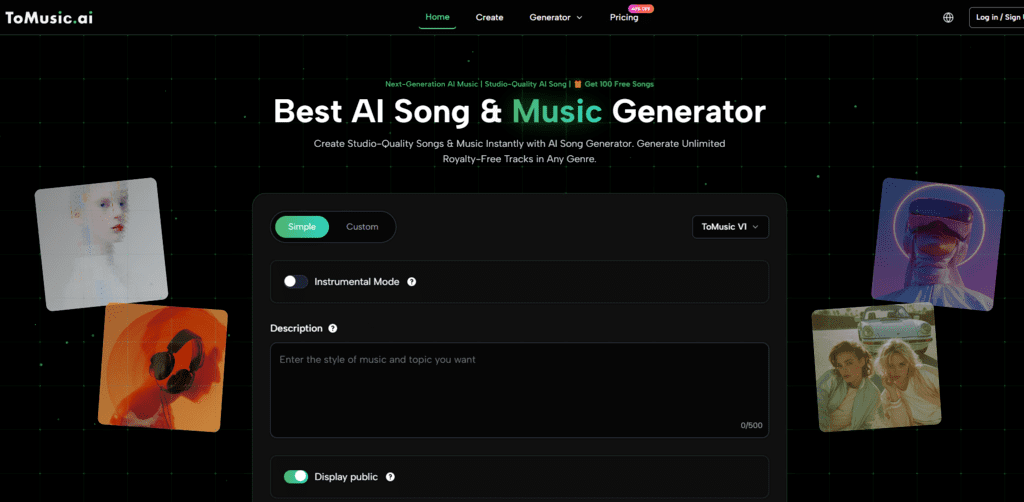
The most useful creative tools are not always the ones that produce the most dramatic first impression. Very often, the better tools are the ones that help people make decisions sooner. That is the perspective from which I reviewed AI Music Generator. Instead of asking only whether the platform can generate songs, I asked whether it helps users answer more practical questions. Which mood fits the campaign? Does this lyric concept feel stronger as a soft vocal piece or a more upbeat track? Is an instrumental version enough, or does the idea need words to land properly? These are decision questions, and they are where music tools often earn their place.
From that perspective, ToMusic feels more purposeful than many lightweight generators. The platform seems structured to move users from idea to comparison quickly. It offers multiple entry paths, a set of guided input controls, and a workspace-oriented flow that encourages reviewing several outputs instead of pretending the first one must be the winner. That makes the product feel less like a toy for isolated prompts and more like an environment for shaping creative direction.
Why Decision Speed Matters In Music Work
A surprising amount of music-related work has nothing to do with final polish in the beginning. The first challenge is often deciding what kind of track should exist at all. A content creator may know the tone needs to feel warm and modern, but not whether that means vocal pop, ambient electronic, or cinematic instrumental. A songwriter may have lyrics and a chorus idea, but still need help hearing possible directions. A brand team may need to test emotional framing before approving production.
In all of these situations, the value of a tool is measured by how quickly it turns uncertainty into options. That is one of the strongest arguments in favor of systems like ToMusic. They reduce the waiting period between concept and evidence.
Creative Delay Usually Comes From Friction
Many good ideas disappear because testing them feels too heavy. If a music tool demands too much setup before any result appears, people stop experimenting. They choose safe defaults or postpone the task. A short browser-based workflow can change that behavior in meaningful ways.
Options Improve Judgment
Creative judgment gets better when users can compare. One track may sound acceptable on its own, but weaker beside a second or third alternative. Products that make comparison easy often improve results indirectly, even if they do not guarantee perfection directly.
What ToMusic Gets Right At The Product Level
The platform’s design seems oriented around manageable complexity. It does not hide the task inside a professional audio interface, but it also does not flatten the experience into a single oversized prompt box.
Mode Choice Creates Useful Separation
Starting with Simple, Custom, and Instrumental paths is a smart product decision. Different creative problems need different degrees of guidance. A quick concept test is not the same as a lyric-led song draft, and an instrumental background piece is not the same as a vocal hook.
The Input Fields Encourage Better Requests
Title, style instructions, lyrics, and trait selectors such as genre, mood, voice, and tempo make the request more legible. In my observation, that kind of structure improves not only the output but the user’s thinking. It forces people to define what they actually want.
The Workspace Layer Supports Ongoing Use
Generated material appears to live inside a music studio area rather than disappearing after creation. That matters because the real value of AI generation often emerges through comparison, not through isolated surprise.
How The Official Flow Supports Decision Making
The platform’s workflow is short, but each step has a specific role in reducing uncertainty.
Step One Establishes The Type Of Musical Task
The mode choice sets expectations immediately. It tells the system and the user whether the goal is speed, greater customization, or instrumental-only creation.
Step Two Breaks The Idea Into Controllable Parts
At this stage, the user can shape the request through title, style, lyrics, and tag-based directions. That is where vague thought becomes actionable input.
Step Three Produces Material To Evaluate
The generation step is valuable not simply because it creates sound, but because it creates evidence. Once a user can hear something, decision-making becomes much easier.
Step Four Keeps Outputs Available For Comparison
Results can then be managed in the user’s workspace. This makes the platform feel more process-oriented than moment-oriented, which is one reason it seems better suited to repeat work.
How I Would Describe The Main Strength
The main strength of ToMusic is that it helps people hear possibilities sooner. That may sound modest, but it is actually significant. In creative practice, speed at the decision layer often saves more time than speed at the execution layer.
It Is Useful For People Who Think In Drafts
Some creators do not need one perfect track from the start. They need three plausible directions to learn what the project wants. For that kind of person, a fast music generator is not replacing talent. It is expanding the number of directions they can test.
It Helps When Words Need Sound Quickly
Because the platform supports lyric input, it can act as an early-stage translation layer between written idea and audible shape. That makes it more interesting than a tool limited to abstract background music.
Where The Review Becomes More Nuanced
A responsible review also needs to ask how deep the product really goes.
The Free Tier Makes Real Testing Possible
A one-time allocation of 100 songs changes the user experience in an important way. It makes experimentation feel safe. Instead of treating every attempt as precious, users can learn how the system behaves, which kinds of prompts work better, and which modes fit their goals.
Paid Plans Add Workflow Functions That Matter
The paid offerings appear to include access to more models, longer song duration, private generation, concurrent jobs, MP3 and WAV downloads, and advanced editing-related tools such as stem extraction and vocal removal. These are practical additions, not superficial perks. They make the product more relevant for people who intend to do more than casual testing.
| Review Criterion | My Reading | Practical Effect |
| Ease of starting | Strong | Low friction for first-time users |
| Control over direction | Moderate to strong | Better than single-box systems |
| Repeat-use potential | Strong | Workspace and quota support testing |
| Commercial practicality | Moderate | Useful features, but still needs judgment |
| Final-polish reliability | Mixed | Some outputs may need multiple attempts |
Why The Multi Model Story Matters
The presence of multiple model versions is one of the more interesting product signals.
Model Variety Usually Reflects Real Creative Tradeoffs
Music generation is not one fixed problem. Vocal quality, speed, arrangement style, and output character may all vary by model. A platform that offers broader model access is usually acknowledging that users have different needs rather than pretending every project fits one engine.
That Makes The Tool More Scalable
A beginner may stay on the simplest path for a long time, but a repeat user often wants greater control, richer output, or different behavior for different projects. A multi-model setup makes that evolution more believable.
What The Product Does Not Solve Completely
This is where honesty matters most.
It Does Not Remove The Need For Taste
Good output still depends on human judgment. A system can generate options quickly, but it cannot decide what fits your audience, brand, or artistic goal better than you can.
It Does Not Eliminate Revision
The real workflow often includes retries. Users may need to adjust style descriptions, simplify or rewrite lyrics, or test different moods. That is part of working with generative systems.
It Does Not Guarantee Uniform Quality
Some tracks may feel immediately useful. Others may feel like near misses. The product is best understood as an engine for options, not certainty.
Which Users Seem Best Matched To The Platform
The audience fit becomes clearer when the product is placed in realistic scenarios.
Solo Creators Benefit From Reduced Delay
For creators who handle writing, editing, publishing, and ideation themselves, a short audio workflow can save meaningful time. Even a decent draft can unlock a stalled project.
Marketers Benefit From Fast Mood Testing
Campaign work often depends on emotional framing. A generator that can provide several tonal directions quickly becomes useful even before the final track is chosen.
Writers And Song Idea Developers Benefit From Audio Feedback
People with lyric fragments or conceptual themes can use the platform to hear possibilities sooner. That feedback loop may help them refine their ideas faster than working only on the page.
A Different Way To Judge Value
Many people ask whether a paid music tool is worth the price. A better question may be whether it saves enough time, confusion, or delay to justify itself.
Value Increases When Comparison Matters
If a user only wants one occasional novelty track, the product may feel like a fun convenience. But if a user regularly benefits from hearing multiple musical directions before making a decision, the platform becomes more strategically useful.
The Product Seems Better For Movement Than Mastery
That is not an insult. It is a positioning insight. The strongest case for ToMusic is not that it instantly masters every musical challenge. It is that it helps users move from uncertainty to choice without needing a full production session.
Movement Is Often The Missing Ingredient
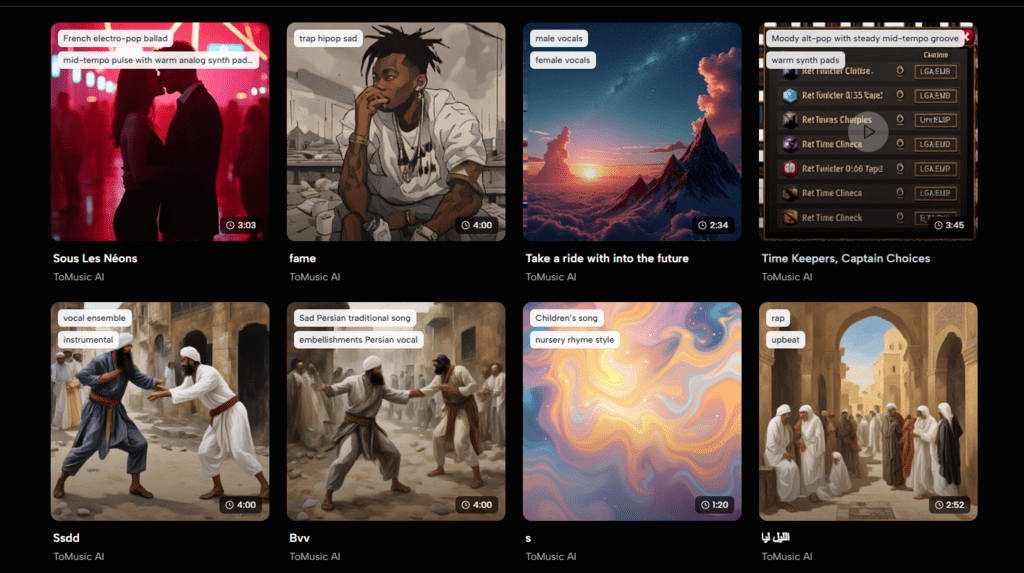
Projects do not fail only because people lack ideas. They also fail because decisions happen too slowly. A good tool accelerates movement without destroying quality judgment.
My Final View On ToMusic
ToMusic deserves attention because it supports a part of creative work that is often ignored: the stage where people need to hear something before they can decide anything. The platform turns musical intention into comparable drafts with relatively low friction, and that alone gives it practical value. Its structured input system, free testing range, workspace-based flow, and broader plan features all point toward a product that wants to be used repeatedly rather than merely demonstrated once.
That is also why the phrase Text to Music feels meaningful here. In the best interpretation, it is not just a technical conversion. It is a decision-making shortcut. It allows words, ideas, and half-formed directions to become audio material quickly enough that the user can react, refine, and choose.
The limitations are still real. Quality varies, iteration remains necessary, and final judgment still belongs to the human creator. But those truths do not weaken the platform’s relevance. They clarify it. ToMusic is most valuable not as a replacement for taste, but as a tool that brings taste into play earlier. For creators who need to decide faster without losing the ability to steer, that is a meaningful advantage.