
 By Simon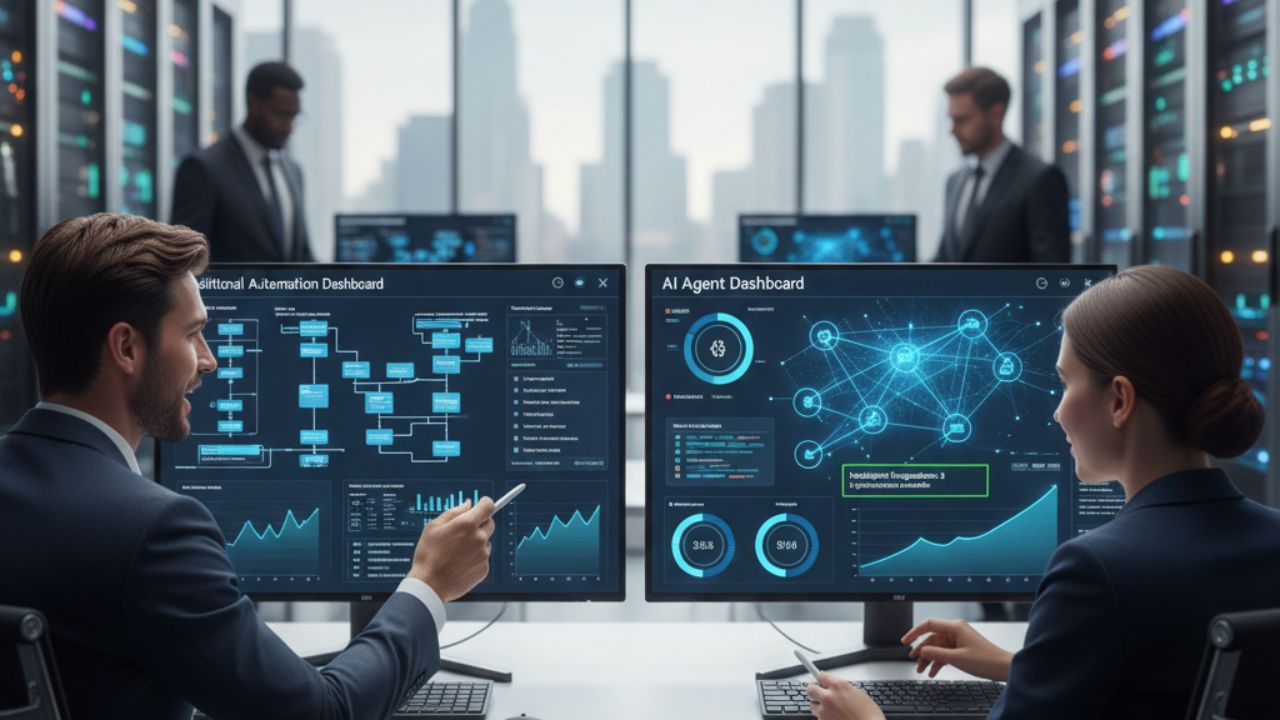
Teams across the U.S. are handling more work than ever. Customer requests come in nonstop. Data piles up faster than people can process it. Departments work across tools that don’t speak to each other. And the moment a business begins to scale, every small inefficiency becomes a cost problem.
To keep up, many companies rely on automation. For years, “automation” meant scripts, macros, bots, and fixed workflows that followed predefined steps. They were useful until workloads became too big and too varied. What once seemed dependable now feels rigid and fragile.
This shift is the reason so many companies are turning toward AI agents. They behave more like digital team members than simple automation bots. They read context, understand instructions, interpret messy inputs, and adjust to new information.
When you compare AI agents vs traditional automation, especially in high-volume environments, it becomes clear why one struggles while the other thrives.
Traditional Automation Breaks Down Under Heavy Workloads
Rule-based tools were built for consistency, not complexity. They repeat the same steps, every single time, with zero flexibility. That’s fine when inputs are clean and predictable. But high-volume work rarely fits that ideal scenario.
As volume increases, traditional automation runs into predictable problems. Inputs vary. Formats shift. People submit requests differently. Systems update their interfaces. A single missing or mislabelled field can cause the entire chain to stop.
High-volume tasks involve real-world conditions: unclear instructions, incomplete forms, unexpected exceptions, and tight deadlines. Traditional automation cannot adjust to these changes. It simply fails and waits for someone to fix it.
This constant oversight drains time and resources, and ironically, increases the very workload automation was meant to reduce.
Why AI Agents Are Built for High-Volume Work
AI agents behave differently from rigid workflows. They understand natural language, read context, identify intent, solve multi-step tasks, and adapt as conditions change. Instead of following one fixed path, they select the right action based on the situation.
Below are the key reasons they excel when workloads increase and become more complex.
1. They work well with messy, mixed, or unstructured inputs
High-volume work rarely arrives neatly packaged. Requests arrive through emails, chats, forms, spreadsheets, PDFs, screenshots, and handwritten notes. Traditional automation needs every input to match its rules exactly.
AI agents don’t.
They can read text, understand tone, extract key information, and classify tasks even when the formatting is inconsistent. This reduces the amount of manual cleanup teams normally do just to “prepare” data for automation.
When the volume rises, this ability becomes crucial because the amount of messy input increases at the same rate.
2. They can adjust to minor changes without breaking
One of the biggest issues with traditional automation is its fragility. A small change—a field name update, a new data column, a different layout—can disrupt the entire flow.
AI agents are much more flexible.
If an email subject changes slightly or a form includes an extra line, they can still understand the purpose of the request. They can identify patterns, learn from previous actions, and adapt naturally to common variations.
This reduces the constant maintenance work that usually comes with high-volume automation.
3. They continue working even when there are exceptions
High-volume environments are full of exceptions. People forget attachments. Customers leave fields blank. Vendors provide partial information. Traditional automation typically freezes when it sees something it cannot match to a rule.
AI agents take a different approach.
They can complete the rest of the task, ask for missing details, choose an alternative route, or send a quick update to the right person. The workflow doesn’t collapse because one small detail was off.
This is a major reason companies prefer AI agents when they expect workload spikes.
4. They handle multiple tasks at the same time
Most rule-based systems process tasks in rigid sequences. As volume increases, these sequences stack up, slow down, and create backlogs.
AI agents work in parallel and respond in real time.
They don’t need a strict order. They can sort tasks, mark priorities, and decide what needs immediate attention. They can also shift between tasks without losing accuracy.
This stabilises throughput during busy seasons or unexpected surges.
5. They work across different systems without complex setup
Traditional automation depends heavily on structured integrations. If one tool updates or changes, the automation may break.
AI agents operate more like human employees.
They can read screens, interpret interface changes, pull data from different places, and complete multi-step tasks without needing every system to be perfectly aligned. This makes them far more reliable in large teams where software changes happen frequently.
6. They improve as they work
Traditional automation stays the same unless someone rewrites its rules. It doesn’t refine itself based on experience.
AI agents learn from repeated tasks.
When given feedback, they incorporate it into future actions. Over time, they become more accurate, respond faster, and make fewer mistakes. As volume rises, this self-improvement helps maintain quality even under pressure.
This long-term scaling ability is something traditional automation cannot match.
7. They support judgement-heavy tasks, not just mechanical steps
Traditional tools handle predictable tasks: move this file, update this field, send this message.
But high-volume work involves many decisions.
Which category does this request fall under?
Who should handle it?
Is it urgent?
Is the information correct?
AI agents excel at these tasks because they understand context. They don’t just act, they assess, interpret, and choose. This makes them suitable for workloads that involve both action and reasoning.
8. They reduce delays without constant human oversight
Most teams spend time fixing automation errors, restarting workflows, or solving issues that occur when something doesn’t match a rule.
AI agents reduce these interruptions because they handle small variations by themselves.
They can fill gaps, correct obvious mistakes, route tasks more accurately, and keep the workflow moving.
Teams spend less time supervising the system and more time working on strategic tasks that actually require human input.
9. They adapt quickly during sudden workload spikes
Whether it’s peak season, a sales push, a new campaign, or a support surge, high-volume periods reveal the weakness of traditional automation.
Rigid systems can’t adjust.
They slow down or fail.
AI agents scale much more gracefully.
They prioritise, route, sort, and self-organise. They absorb sudden increases without sacrificing quality or speed.
This adaptability is one of the biggest reasons businesses are replacing old automation tools.
10. They produce clearer activity trails and explanations
When traditional automation fails, the logs are often cryptic. Someone has to manually reconstruct what happened.
AI agents can explain their actions.
They can outline steps, mention the input they used, and summarise why they chose a particular path. This improves auditability and reduces time spent diagnosing issues.
For high-volume operations, this transparency helps teams catch small problems early.
AI Agents vs Traditional Automation: The Difference Is Flexibility
When comparing AI agents vs traditional automation, the core difference is simple:
Traditional automation works only when inputs are predictable.
AI agents work even when they aren’t.
High-volume work is rarely predictable, which makes AI agents far better suited for modern operations. They adapt, understand variations, and keep processes moving with far fewer interruptions.
Conclusion
High-volume workloads expose the limits of traditional automation. It breaks easily, requires constant supervision, and falls apart when conditions change. AI agents offer a smarter approach. They can interpret instructions, adjust to new scenarios, and handle exceptions without slowing down the entire system.
They behave like reliable digital colleagues who understand context, follow through with multi-step tasks, and grow more capable over time. This makes them far more effective for companies dealing with rising demand, expanding operations, and increasing task complexity.