






When Love Becomes a Battle Against the Wild
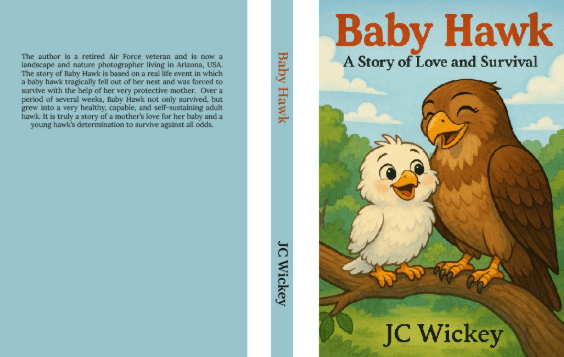
In JC Wickey’s Baby Hawk – A Story of Love and Survival, love isn’t gentle. It’s sharp, relentless, and willing to face the dark without flinching. The story begins with an accident, a young hawk falling from the safety of her nest, but the heart of the book belongs to her mother. From the moment Baby Hawk hits the ground, Momma Hawk’s world changes. She’s no longer just a caretaker; she becomes a defender, strategist, and survivor. Wickey doesn’t portray her as flawless, he shows her exhaustion, fear, and doubt, but that’s where her power lies. She protects because she must, not because she knows she can.
When Instinct Turns into Endless Responsibility
The moment Baby Hawk falls, Momma Hawk’s instinct ignites. She dives from the tree, frantic yet focused, realizing that her baby can’t be lifted back up. The nest, once their safe home, is now unreachable. That realization reshapes everything. The wild no longer belongs to both of them, it belongs to her alone to manage and control. Wickey uses the scene to show how love adapts faster than reason ever could. Momma Hawk studies her surroundings like a soldier surveying a battlefield. Every rustle in the grass becomes a potential threat, every shadow something to confront. She knows no rest is coming. From that moment forward, her life becomes a cycle of vigilance.
The Night That Measured the Depth of Her Courage
When the sun disappears, fear becomes a physical thing. Darkness settles, and the air thickens with unseen movement. Momma Hawk stays awake, her eyes scanning for predators. Wickey writes the night scenes with quiet intensity; every sound carries weight, every second stretches longer than the last. Then comes the coyote. It moves closer, curious about the white fluff sleeping in the grass. The mother doesn’t hesitate. She strikes with speed and fury, hitting it hard enough to make it flee. That moment defines her. It isn’t instinct alone, it’s decision, precision, and love sharpened into survival. Wickey’s writing makes the reader feel her exhaustion, her pulse, and her raw courage.
The Relentless Days That Followed Without Relief
The danger doesn’t end with dawn. The heat arrives with new challenges. Wickey writes the daylight with a heavy stillness, no breeze, no rest, just endurance. Momma Hawk keeps moving between hunting and guarding, too aware that she can’t fail even once. The baby, still grounded, begins to explore, unaware of the predators that could end everything in seconds. Each day stretches into the next. Hunger presses down like the sun itself. Yet even through exhaustion, the mother doesn’t retreat. She fights a rattlesnake one day and faces a camouflaged owl another. These encounters aren’t written as fantasy; they’re presented as survival in its purest, most instinctive form. Every strike, every meal, every defensive cry adds another layer to the story’s unspoken truth: a mother’s strength is rarely seen in comfort; it’s proven in chaos.
The Moment When Weakness Almost Took Over
After countless days of danger and heat, Wickey slows the rhythm of the story. Momma Hawk begins to falter. Her body grows weaker, her spirit heavy from sleepless nights. She’s close to breaking. It’s one of the quietest yet most powerful moments in the manuscript. For the first time, the reader feels her limits. She’s not an untouchable force; she’s a creature of flesh, feathers, and fatigue. Then, as if guided by something beyond instinct, she spots movement, a lizard in the dirt. The simple act of hunting becomes her renewal. That small meal revives her energy and her determination. Wickey uses this moment to remind us that strength isn’t about never reaching the edge. It’s about finding the will to pull yourself back when you do.
Teaching Strength Without Words or Lessons
As Momma Hawk regains her strength, the story begins to shift toward hope. Baby Hawk’s wings are stronger now, her attempts at flight less clumsy. The mother watches closely, allowing her space to fail, to learn, to grow. There’s no dialogue, no lessons, just presence. Wickey turns silence into communication. The mother doesn’t need to push her child; she trusts her. The manuscript transforms this wordless guidance into something profound: love doesn’t always need instruction. Sometimes it’s enough to stay close until the other learns to rise simply.
When the Circle of Care Turns into Independence
The day Baby Hawk finally takes flight feels like a release, for both of them. She flaps her wings, stumbles, tries again, and finally lifts into the air, reaching the nest on her own. Wickey writes that moment without grandeur. It’s not cinematic; it’s deeply emotional. For Momma Hawk, it’s both victory and goodbye. She’s done what every parent must do, prepare her child to survive without her. The beauty of the ending lies in its simplicity. There’s no dramatic farewell, just quiet satisfaction. Time passes, and Baby Hawk grows into an adult, strong and capable, a mother herself. The final pages mirror the beginning, closing the circle. The same love that once protected her now flows through her to another generation.
The Legacy That Survival Leaves Behind
By the last page, Baby Hawk – A Story of Love and Survival becomes more than a nature story; it becomes a reflection of life’s truest rhythm. Every creature, every parent, every moment of endurance echoes the same pattern: protection, loss, growth, and renewal. Wickey doesn’t write Momma Hawk as a symbol; he writes her as truth. Her love is not gentle, it’s fierce, unpolished, and undeniably alive. That’s what makes this story linger. The lesson isn’t about flying; it’s about the fight that happens before the flight ever begins.